
Agric
Crashing food prices, sustainable solution to food insecurity? Farmers ask

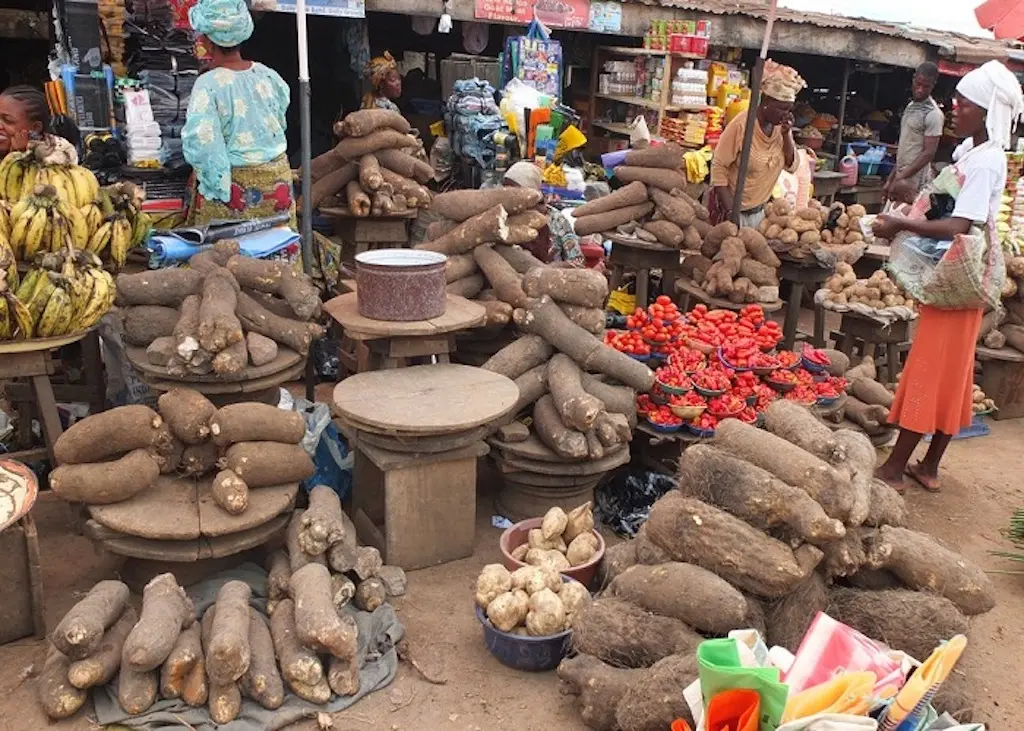

The prices of agricultural produce in Nigerian markets plummeted in recent months. The sharp fall in prices is a deliberate move by the President Tinubu-led Federal Government to ensure ‘no Nigerian goes to bed on an empty.
A bag of paddy rice that was hitherto sold at N100,000 in local markets in December 2024, now goes for about N45,000 only. A bag of raw groundnuts that was sold for N90,000 at this period last year is now N35,000.
A visit our correspondent to some local markets in some states, particularly those in the North Central region, indicates that the situation is the same with almost all crops, ranging from grains to tubers.
The free fall of food prices started when the Federal Government temporarily opened its borders for a 150-day window in July 2024 to allow duty-free imports of essential food items like rice, maize, and wheat.
Abubakar Kyari, the Minister of Agriculture and Food Security, explained that the measure was taken to combat rising food prices and alleviate the high cost of living for millions of Nigerians.
“Over the past several months, we have all been witnesses to the escalating cost of food items in all parts of the country.
“There is virtually no food item that has not had its price raised to a level higher than what a good many Nigerians can afford,” Kyari said.
The argument was to stabilise food prices and address a supply deficit following a surge in staple food prices and social unrest.
On Sept. 10, President Bola Tinubu again directed a Federal Executive Council committee to move swiftly and implement measures to further reduce food prices across the country.
Also, according to the Minister of State for Agriculture and Food Security, Sen. Aliyu Abdullahi, the move is to ensure that no Nigerian goes hungry.
Aliyu said that the directive was also to ensure the safe passage of farm produce across transport routes to cut logistics costs.
“The President has directed a Federal Executive Council Committee to ensure safe passage of agricultural foods and commodities across our various routes in the country,” he stated.
The minister pointed out that the plan was tied to Tinubu’s broader vision of food sovereignty beyond availability to ensure affordability, accessibility, and nutrition on a sustainable basis.
While consumers heave a sigh of relief with the astronomical drop in foodstuff prices, farmers and key stakeholders on the other side of the coin find the decision absurd and anti-agricultural growth and development.
To Mr Joseph Unogwu, Country Director, Agricultural Development for Economic Growth Initiative (AgDEG), flooding the Nigerian market with imported food meant destroying the local capacity to produce.
According to Unogwu, by ceding its food production to another country, Nigeria is still completely food insecure, adding that if anything goes wrong internationally, the country has a lot to lose.
The country director stated that without empowering local production, but focusing on just the price, Nigeria had become a dumping ground for other countries that were supporting farmers to produce in larger quantities at minimal cost to the farmers.
According to him, farmers are leaving their farms because of high production costs and the extremely low cost of farm produce with no incentive.
“Crashing the prices of food when farmers are in the field farming with high costs of inputs is simply driving the farmers away from production. I see this policy, whether a stopgap or long-term measure, as ill-timed.
“That simply means that we have more farmers being disenfranchised in their farms within Nigeria.
“We are creating more unemployment by destroying the livelihood of smallholder farmers in the rural settings by crashing the food prices without doing anything to support local production.
“In many communities we have been to, especially in the North, farmers have abandoned their farms as a result of this policy.
“The importation will put pressure on our naira. The same Federal Government said three weeks ago that the import wage bill was over 10 billion dollars, and that such was not sustainable for the economy.
“We are weakening the naira, exposing the country to impending hunger and putting rural areas at high risk of making youth available for recruitment into different crimes.
“It has a multidimensional effect. If the government has done something to boost production by providing agricultural inputs such as fertilisers, agrochemicals, and other inputs to support the farmers, I will describe this as the right step in the right direction.
“It means that we just focused on food price rolling back on the milestone that Nigeria has achieved in agriculture by becoming import dependent,” he added.
Mr Vitalis Tarnongu, Chief Executive Officer of Teryima Nigeria Limited, an agricultural company based in Benue, described the Federal Government’s price control efforts as anti-farmer.
Tarnongu argued that the decision was a case of putting the cart before the horse as the logical thing to do was to carefully look at the variables that pushed up prices of food commodities.
The CEO of Teryima Nigeria Limited, who is also the Benue State Coordinator of the Federation of Agricultural Commodity Associations of Nigeria (FACAN), said that in spite of the measure, the prices of farm inputs remained outrageously high.
“Is it not logical for the government to slash the prices of inputs before farm produce? If the government means well, it should be inputs first because it is through the inputs that farmers cultivate, plant and nurture the crops to harvest.
“The decision is killing and will kill agricultural businesses completely if the trend is not reversed immediately.
“Farmers can no longer afford farm inputs such as fertilisers, herbicides, pesticides, and many other crucial inputs.
“This is so because farmers normally sell the produce to purchase the inputs. And what farmers are selling now, they won’t be able to buy inputs to go to the farm next farming season.
“I heard that the government is giving out farm inputs to farmers at subsidised rates, but farmers are yet to see them.
“If a farmer of my status has not seen such, where will local farmers in the villages see the subsidised inputs?” he asked.
Is crashing the farm produce prices the solution? A stakeholder in the agricultural sector, Mr Thaddeus Ogwuche asked.
“I asked this question because inherent in this executive order is insensitivity to the plight of the ordinary farmers.
“On the surface of the order (or is it policy?) is a facade of empathy for the starving and malnourished citizens, but underneath is a poisoned chalice of politics of convenience.
“For a start, you don’t decree prices of goods and services into existence in an unregulated free market economy. Pricing and prices are the end products of the interactive twin market forces of demand and supply.
“You are crashing prices of foodstuff without a corresponding crash in the prices of farm inputs. What kind of economic model have you adopted?” he asked.
Mrs Veronica Iorwuese, a peasant from Ye, Guma Local Government Area of Benue, said that she was stranded, as she could not pay her children’s first-term school fees.
Iorwuese, a widow, said that she invested all resources into farming, but on harvest, the prices of commodities had fallen to an all-time low.
“Before now, I used to sell a basin of corn to buy one litre of herbicide, but now proceeds from a basin of corn cannot buy a litre of herbicide, let alone a bag of fertiliser.
“I used more than N50,000 to farm maize, but now I cannot get half of that amount.
“I went to my children’s school; their school fees have increased, and I am stranded. If only I knew, I would have kept the little I had instead of wasting my time and resources on farming.
“I am certain that I will not be able to farm next year because I no longer have the resources to afford herbicides, pesticides and fertiliser, among many other farm inputs,” she cried.


NIGERIA DECIDES

 Davido's Net Worth & Lifestyle
