
POLITICS
Anambra 2025: Soludo’s victory and underlying factors

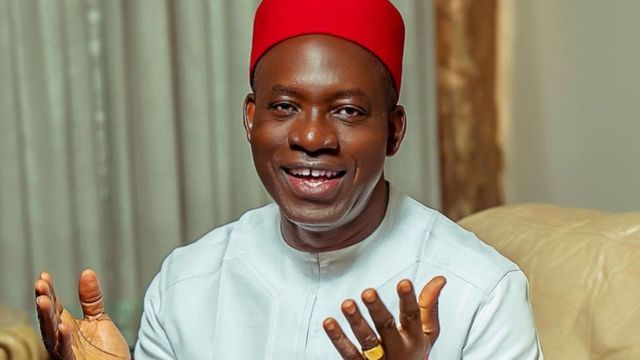

The much-anticipated and action-packed governorship election in Anambra came to an end on Nov. 9, with the declaration of Prof. Chukwuma Soludo of All Progressive Grand Alliance (AGPA) as the winner of the poll.
Going by the result declared by the Returning Officer of the election, Prof. Edoba Omoregie, Soludo scored 422,664 votes to defeat his closest rival, Mr Nicholas Ukachukwu of All Progressives Congress (APC) with 99,445 votes.
While Paul Chukwuma, the candidate of Young Progressives Party (YPP) secured 37,753 votes, his Labour Party counterpart, George Moghalu, scored 10,576 votes and John Nwosu, of African Democratic Congress (ADC), 8,208 votes.
While reacting to the outcome of the election, Soludo thanked the people of the state for re-electing him for another term of four years.
“Now that the people have spoken, let us get back to work,” the elated governor said in his country home, Isuofia in Aguata Local Government Area of the state.
“I am back in the office; it is a 24/7 assignment, and we cannot wait. ‘Ndi’ Anambra cannot wait.
“The job to be done is still a lot; it is an assignment with a deadline,” he said.
For some of Soludo’s opponents however, the election fell short of an acceptable standard.
For instance, Ukachukwu, alongside the governorship candidates of African Action Congress (AAC), Chioma Ifemeludike, raised concerns over what they called vote buying during the exercise.
Ukachukwu described voting buying and intimidation of his party agents as criminal and a threat to the integrity of the democratic process.
According to him, any attempt to influence voters with money undermines citizens’ civil responsibility and the credibility of elections.
Also, Moghalu said the outcome was not a reflection of the wishes of the people of Anambra.
“The truth about it is that the election is actually not a true reflection of the wishes of ‘ndi’ Anambra (people of Anambra).
“A few things went wrong; the issue of vote-buying; there were instances where there was voter intimidation and party agents were brutalised.
“There were a few things that happened before the election, which brought us to where we are today.
“When I heard the number of policemen deployed to manage this election, I felt confident, but here we are.
“The policemen were around, but people were seen buying votes everywhere, and it was clear,” Moghalu claimed.
Reports, however, indicate significant improvements in logistics and technology by the electoral umpire, Independent National Electoral Commission(INEC), thus contributing largely to the peaceful and efficient conduct of the election.
“In short, the election marked progress in operational efficiency and transparency.
“The fact that results were declared and accepted without major disruption shows that INEC can conduct credible elections even in challenging contexts,” a newspaper columnist remarked.
He also noted a marked improvement in voter turnout, stating that it doubled from 10 per cent in 2021 to about 22 per cent this time.
Of particular concern, however, is voter apathy which trailed the election in Anambra, like previous polls in other parts of the country.
For instance, out of the more than 2.8 million registered voters, only 584,054 votes, representing 16.4 per cent, were recorded during the election, out of which Soludo scored 422,664, leaving 161,390 votes to be shared by other candidates.
A civil society organisation, Yiaga Africa, attributed the voter apathy to weak communication from political parties and a sense of disconnection among citizens.
The CSO, in a statement issued by its Executive Director, Samson Itodo, stressed the need for a national conversation on low voter turnout, which it described as a growing crisis threatening the legitimacy of democratic governance.
Itodo said that youth disengagement remained particularly troubling and called for renewed efforts to rebuild public confidence in elections.
“The persistent decline in turnout, especially among young Nigerians, raises serious questions about the health of our democracy,” he warned.
But for Transition Monitoring Group (TMG), the election was largely credible, saying that results were openly counted at polling stations in the presence of party agents, voters and security officers before being uploaded to the INEC Results Viewing (IReV) portal.
Meanwhile, analysts have attributed the overwhelming victory recorded by Soludo in the governorship election to a number of factors.
According to them, the governor’s landslide victory did not just reaffirm his popularity; it also reinforced the ruling APGA’s dominance in the political landscape of the state.
They also highlighted a combination of political structure, incumbency advantage and voter perception as key factors that shaped the outcome.
The development might also be a reaffirmation of people’s confidence in Soludo’s leadership style and what was largely seen as his stellar performance, reflecting in infrastructural development, education and health sector reforms as well as urban renewal programmes and public service initiatives.
Aside the fact that APGA is deeply rooted in Anambra, there appears to be an emotional attachment to the party.
Indeed, an average citizen of the state sees APGA as representing the image and political ideology of the late Chief Chukwuemeka Ojukwu which they will not want to be wiped away by the coming of another ruling party.
The governor equally appeared to have explored APGA’s solid structure to ensure effective mobilisation of supporters and citizens in all the nooks and crannies of the state, resulting in massive vote for him.
The incumbency advantage might equally not be ruled out in Soludo’s brilliant showing in the election.
Political observers also hinge the governor’s victory on fragmentation of the opposition.
According to them, while APGA and its candidate are intact, several candidates from other political parties, including PDP, ADC, APC, Labour Party and YPP are fragmented, thus creating an ample opportunity for Soludo and his party.
More so, the rapprochement between President Bola Tinubu and Soludo was seen as playing a major role in the latter’s impressive showing in the election.
Tinubu had, in his personally-signed congratulatory message to Soludo shortly after the declaration of result by INEC, described his victory as a resounding affirmation of his visionary leadership.
He also pointed out that the victory underscored the people’s confidence in Soludo’s leadership and the progress which the state had recorded under his administration.
“Soludo, the ‘Solution,’ has demonstrated that knowledge is power and that academic principles can be effectively applied in serving the people,” he said.
It should be equally stated that the president had, in May, visited Anambra during which he inaugurated several projects executed by the Soludo administration.
“The innovation and strategic thinking behind these projects were remarkable and remain indelible in my mind.
“Under his (Soludo’s) leadership, Anambra is truly living up to its motto as the Light of the Nation,” Tinubu remarked during the visit.
Soludo, on his own, had, on several occasions, openly displayed support for Tinubu, defending his administration’s policies and programmes, a development largely seen as a reflection of the working accord between the two leaders.
This is believed to have been cemented by the appointment of a prominent leader of APGA and wife of the late Chief Emeka Ojukwu, Bianca Odumegwu-Ojukwu, as minister in the Tinubu administration.
Watchers of political events in the state, however, stress the need for opposition parties to establish strong grassroots presence to be able to challenge APGA in subsequent elections in the state.
They say the rate at which the governor is able to sustain his impressive performance and connection with the people of the state, both of which combined together to earn him a second term victory, will go a long in determining the future of APGA in Anambra.


NIGERIA DECIDES

 Davido's Net Worth & Lifestyle
