
Agric
Post-harvest losses: Oyo women farmers struggle after harvest

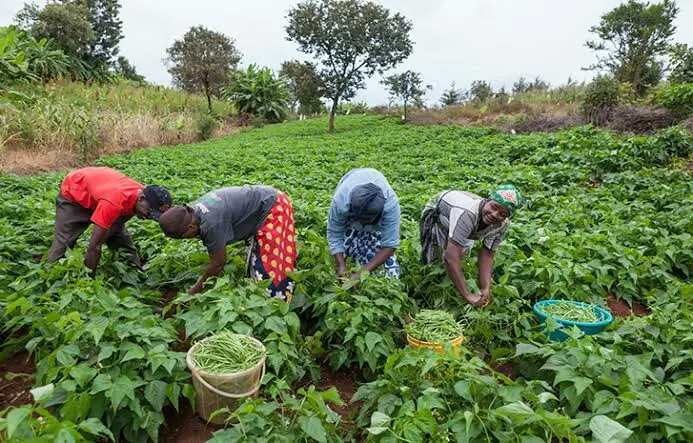

Mrs Kudirat Salami, a smallholder farmer in Apaadi community, Oluyole Local Government Area of Oyo State, harvested her tomatoes early, packaged them carefully and made to transport them to the market.
After five years in vegetable farming, she believed proper planning would secure her income.
But delays caused by bad roads, police checkpoints and the absence of storage facilities worked against her.
By the time her produce arrived at the market, prices had crashed and buyers rejected bruised and spoiling tomatoes.
“I could not sell anything that day. Some were already going bad. Others were rejected. At the end of the day, I was asked to pay to dispose of them, Salami said.
For many women farmers in Oyo State, losses do not begin from the farm. They begin after harvest.
Across farming communities in the state, timing has become a matter of survival for women who grow and trade perishable crops.
Mrs Temilade Olabiyi, leader of the Smallholder Women Farmers Organisation in Nigeria (SWOFON) in Oluyole LGA, said that post-harvest losses often stem from market timing rather than poor yields.
“You must look for the market before you plant. If you plant outside premium demand periods, you are forced to sell cheaply or watch your produce rot,” she said.
With tomatoes and peppers operating on short planting cycles, she explained that one wrong decision could wipe out an entire season’s income.
For many women farmers, losses begin even before reaching the market.
Poor rural roads and long travel times cause bruising and spillage, especially as farm produce are often packed in traditional raffia baskets.
“By the time we get to markets like Bodija or Oje, deductions start immediately. You pay ground rent, stall fees and other charges even before making a sale,”Olabiyi said
According to her, delays give middlemen leverage to dictate prices, leaving farmers with little choice but to accept losses.
Mrs Oluwatoyin Oyedeji, a smallholder farmer in Oyo town, said rising transport costs and levies forced her to stop selling in major markets.
According to her, the arithmetic no longer adds up,
“Sometimes, transport and levies compete with my profit. I barely recover my costs.”
At major markets including Bodija, Sasa, Akinyele and Omi-Adio, women farmers and traders told NAN that they faced multiple levies, many undocumented.
Moving perishable goods from farm to market
Mrs Bolanle Raimi, a potato vendor at Omi-Adio market, said that charges began long before profit was considered.
“A bag that once attracted N200 levy now costs up to N1,000. We are paying to sell, and when goods spoil, we pay again to dump them,” she said.
She said that many levies were imposed by middlemen rather than government officials, often without receipts.
According to Raimi, middlemen operate in coordinated groups, fixing prices and limiting farmers’ bargaining power.
“If a farmer refuses a price, others will insist on the same amount. They work together.”
The Iyaloja of Omi-Adio Market, Alhaja Mojisola Latinwo, acknowledged the challenges, but said that the market handled fast-moving goods with minimal spoilage.
She said that traders pay N50 ticket fees to the market union and N50 per basket to local government revenue officers.
However, traders insist that these figures do not reflect the full cost imposed through informal charges before farm produce reach stalls.
Latinwo also blamed poor road conditions, particularly during the rainy season, estimating losses at between 10 per cent and 20 per cent.
Beyond roads and levies, the absence of storage facilities remains a critical challenge.
Mrs Oluwafolakemi Omidiwura, a post-harvest researcher at the University of Ibadan, said that the lack of cold storage allowed middlemen to use time as leverage against farmers.
“Fresh produce are sometimes delayed until older stock is sold. The longer the delay, the more decay sets in.”
Without storage, farmers must sell immediately, accept low prices or lose everything.
Traders of perishable goods and how the goods are transported to and fro the market.
Raimi, a mother of four, said she sometimes lose up to half of her goods, adding that it affects her ability to feed her family and pay school fees.
“Sometimes we eat from what is left unsold. When losses are heavy, it becomes difficult to survive.”
Aggregators also feel the strain.
Mr Emmanuel Akinsoji, who has worked in produce aggregation for over 25 years, said that delays and heat destroyed value quickly.
According to him, it can take three days to move produce from the North to the South.
He said that a bag that sells for N80,000 in the morning may go for N35,000 in the evening.
Stakeholders described post-harvest loss as a structural threat to food availability and affordability.
They said that Nigeria lost up to 40 per cent of fruits and vegetables after harvest, not because solutions are unknown but due to weak implementation.
They cautioned against chemical preservatives and called for research into low-cost, electricity-free storage options such as evaporative cooling systems.
Mr John Olateru, National First Deputy President of the All Farmers Association of Nigeria (AFAN), blamed years of policy inertia.
“Farmers absorb losses while conferences continue. Without cold-chain infrastructure and processing hubs near farms, losses will persist,” he said.
Investigations show that many market levies form part of local government Internally Generated Revenue, now often collected by private consultants.
Officials in Akinyele LGA, who craved anonymity, said contractors collect revenues, remit agreed sums and operate with limited transparency.
A rate officer in the council said official ground rent ranged from N1,200 to N5,000 depending on stall type, but admitted that several markets are no longer under direct council collection.
The Oyo State Government says it is addressing post-harvest losses through infrastructure and market reforms.
The Director-General of Oyo State Agribusiness Development Agency, Dr Debo Akande, said about 1,200 kilometres of feeder roads were under construction to improve farm access.
He said that aggregation centres were being developed and that at least 16 medium-scale processing factories had been attracted as off-takers since 2019.
The Commissioner for Agriculture and Rural Development, Mr Olasunkanmi Olaleye, said that the state was developing an Agricultural Information Management System with a virtual market to link farmers directly with buyers.
He also disclosed plans for a 10,000-metric-tonne silo project and agro-logistics centres in partnership with development agencies.
On market levies, Olaleye said collection fell under local governments and traditional authorities, stressing that the state does not engage contractors for market levies.


NIGERIA DECIDES

 Davido's Net Worth & Lifestyle
