
POLITICS
Ekiti: How unity, ‘omoluabi’ politics delivered Oyebanji’s historic 2nd term win

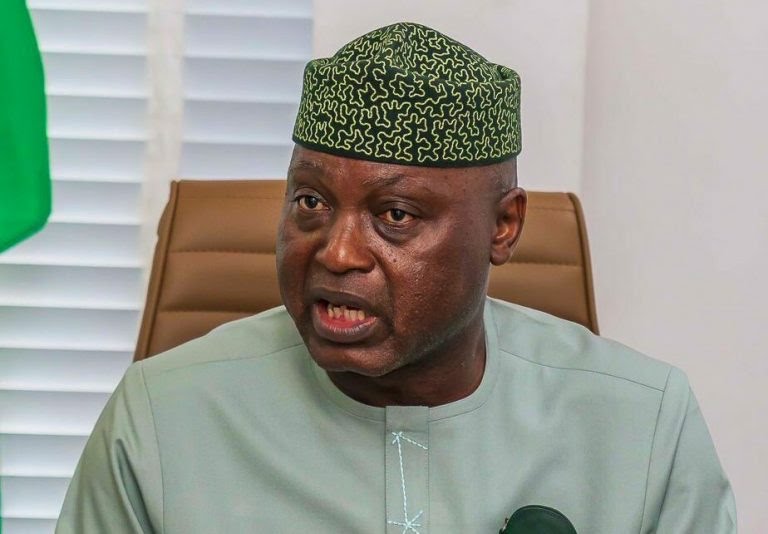

For Mr Biodun Oyebanji, the Governor of Ekiti, it was a sweet victory as he was declared the winner of the governorship election held in the state on June 20 by the Independent National Electoral Commission (INEC).
The Returning Officer, Prof. Adenike Oladiji, said Oyebanji scored a total of 319,224 votes to defeat his closest rival, Dr Wole Oluyede, who polled 40,543 votes, while the African Democratic Congress (ADC) candidate came a distant third with 12,872 votes.
The result indicated that the governor, who contested on the platform of All Progressives Congress (APC), won in all the 16 local government areas of the state, scoring a total of 83 per cent of the total votes cast during the exercise.
Analysts say the outcome of the election was a consolidation of a statewide sweep that reflected strong performances by Oyebanji across urban and rural voting blocs.
The conduct of the governorship election, which gave Oyebanji a historic victory, has since generated mixed reactions from individuals, political parties, election observers, civil society organisations (CSOs) and other stakeholders within and outside the state.
While some applauded INEC for conducting what they described as free, fair and credible election, others were of the opinion that the exercise was not without its shortcomings.
For instance, a coalition of human rights organisations, under the aegis of Nigerian Human Rights Community (NHRC), said the outcome of the election reflected the democratic will of the people of Ekiti.
Addressing a news conference in Lagos, the coalition, which deployed 200 monitors across the state, led by Martins Adeleke, Fred Ojinika and Akinwale Kasali, described the election as the aggregate expression of the democratic aspirations of Ekiti voters.
While commending the people of the state for a peaceful and orderly turnout, the coalition said that the exercise was free of the violence, ballot snatching and brigandage that characterised past elections in the state.
It particularly hailed INEC for ensuring real-time transmission of results, describing the process as transparent and accountable.
The coalition equally said that the election met international standards, attributing the feat to INEC reforms and the credibility, transparency and professionalism of the Resident Electoral Commissioner, Dr Bunmi Omoseyindemi, and his team.
It noted that the deployment of Bimodal Voter Accreditation System (BVAS) eliminated ballot snatching, manipulation of the voters’ register and use of fake voter registers, thus rendering vote-stuffing-related thuggery unattractive.
Another CSO, Yiaga Africa, also observed that the official election results announced by INEC were consistent with its independent verification estimates.
The organisation, in its post-election Process and Results Verification Statement issued by the Chair of its 2026 Ekiti Election Observation Mission, Aisha Abdullahi, said its Watching The Vote (WTV) Process and Results Verification for Transparency (PRVT) methodology showed that the results fell within its estimated range.
This, it said, indicated that the figures reflected ballots counted at polling units across the state.
Yiaga Africa also stated that the consistency between its estimates and INEC’s declared results specifically supported the accuracy of the polling-unit result tabulation.
Notwithstanding the validation of the official results, the organisation expressed concerns about reports of vote-buying and voter inducement during the election.
“Widespread reports of vote buying and voter inducement raise serious concerns about the integrity of voter choice and the extent to which the outcome reflected the free will of the electorate,” it stated.
The organisation urged INEC to improve clarity and coordination in implementing provisions of the Electoral Act 2026 and its regulations, particularly regarding election-day procedures and the use of downloadable Permanent Voter Cards (PVCs).
It also stressed the need for security agencies to intensify efforts to apprehend and prosecute electoral offenders, stressing that vote buying and voter intimidation increasingly occur around polling units rather than inside them.
To the opposition political parties, the conduct of the election was short of expectation, with widespread vote-buying, ballot irregularities and administrative lapses by INEC implicated.
Although the opposition parties acknowledged improvements in logistics and the largely peaceful nature of the polls, they, however, raised questions on allegations of vote-buying, omissions on ballot papers and INEC’s preparedness for future elections.
The National Publicity Secretary of Social Democratic Party (SDP), Rufus Aiyenigba, accused the electoral umpire of undermining confidence in the process.
While acknowledging that there was a remarkable improvement in logistics movement, Aiyenigba described what he called rampant vote-buying as a dent in the integrity of the election.
He also said that ‘deliberate shutting out’ of SDP by way of not allowing for the uploading of the names of party agents for the election rendered the election a nullity.
“Nigerian citizenry must rise up and resist the deliberate breach of the faith and trust of the people in our electoral processes and outcomes, occasioned by the unholy pact of administrators of our elections with anti-democratic agents,” he said.
Similarly, the National Publicity Secretary of Nigeria Democratic Congress (NDC), Osa Director, said though the election was devoid of violence, it was marred by allegations of vote-buying and other irregularities.
“I don’t know why INEC allowed people to get away with vote buying right under the watch of its officials.
“Again, I don’t know how some persons were also in possession of voters’ cards that don’t belong to them. That also begs the question of how they managed to access it.
“These are inadequacies and lapses that must be corrected before the 2027 general elections,” Director said.
In all of these, the fact remains that Oyebanji, with his victory, has made history in the state’s political landscape as the first governor to have won second term back-to-back in the history of the state.
While two of his predecessors, Mr Ayo Fayose and Dr Kayode Fayemi, served two non-consecutive terms, Oyebanji won his unprecedented re-election consecutively.
Political pundits have attributed this feat to a number of factors, including Oyebanji’s ability to form a broader political alliance across the state as well as the power of incumbency.
They also point to the governor’s performance in some key sectors, including infrastructure, education, health, workers’ welfare and delivery of democracy dividends to the generality of Ekiti people.
It is on record that the governor had, since assumption of office in 2022, embarked on subtle diplomacy, thus succeeding in having all his predecessors – Niyi Adebayo, Ayo Fayose, Segun Oni and Kayode Fayemi – on his side.
Besides, Oyebanji also has the support of virtually all APC elders, leaders, senators, members of the House of Representatives, other political office holders and notable political figures across the state, thereby forming a strong political alliance ahead of the election.
Observers say this was apparently lacking in the opposition parties, many of which went into the election divided, contributing largely to their poor showing at the election.
While predicting his principal’s victory shortly before the election day, Oyebanji’s Special Adviser on Media, Yinka Oyebode, described the governor as a peace-loving person, saying that he gave all the political parties free space to campaign across the state.
Oyebode said previously, the state used to record some forms of violence during elections because of the stifling of political activities of the opposition by the government in power.
“The governor regards Ekiti citizens as one entity, hence the enabling environment given to the opposition parties to operate freely.
“Everyone in Ekiti enjoys equal rights and freedom, irrespective of political, religious or cultural affiliations,” he said.
The governor’s aide attributed violence that usually trails elections to what he called reactionary actions of the opposition from hostile political environment, most times created by the government in power.
Reviewing the process so far, Oyebode said that the governor, as the leader of the ruling APC, had prioritised unity and peaceful co-existence throughout his governorship campaigns.
“As we speak, all the past governors of the state and majority of political heavyweights interact freely under the leadership of the governor.
“Again, there is no report of the opposition saying that they were not allowed to operate, unlike the situation before now,” he said.
Oyebode attributed the governor’s ‘resounding victory’ at the poll largely to his ‘omoluabi’ ethos which, he said, had been his guiding principle since his assumption of office in 2022.
For the ruling APC, the governor’s victory consolidates its dominance in Ekiti politics, while for the opposition, the wide margin in the election results exposes the cost of internal division, lack of cohesion and fragmented campaign strategies.
As Oyebanji prepares for the take-off of second term in office on Oct. 16, analysts say the mandate places fresh expectations on him to translate the electoral goodwill into tangible development for a state largely seen as both rural and urban.
To them, the governor’s legacy in Ekiti rests on a simple metric—whether he can sustain his signature omoluabi philosophy while delivering the concrete results he promised during his campaign.


NIGERIA DECIDES

 Davido's Net Worth & Lifestyle
